Thursday, September 27, 2012

Kayaking with the Swedish Outdoor Academy in Bohuslӓn


From a dream I awake in Bohuslӓn in a car. Back-seat sleeping beats back-seat driving. Sleepily I follow Felix and Axel from Point65 to join outdoor people from all over the world for the Outdoor Academy of Sweden

From Grebbestad we were about to float out in groups between the islands and rocks of the Swedish west coast archipelago, paddling Point65kayaks. But first, there are several sponsors and in the building with all the kayaks are neatly arranged piles of equipment, one for each person and some for each tent group. We don’t need to bring much of our own: this trip will be a showcase for Scandinavian design.
Leading my group from the beach is Christina who guides trips in the archipelago for a living. I’m comfortable from the moment she starts. Some of her first words explain how much she is love with the rocks. 

Bohuslӓn is a place of rock and water. The ice sheet of the last ice age smoothed the rock surfaces, grinding them smooth as silk, and leaving subtle curvaceous edges between undulating faces. Stones frozen into the slowly moving ice gouged grooves across that suggest the work of a giant comb. The sea has since added its mark on the slowly rising land, and the salt creates a border, allowing the gradation of more or less salt-tolerant species to cling to the faces in different colored bands. Above I see tiny flowering plants clinging to cracks, and the lichens and mosses, trees and grasses that sometimes struggle to make this part of Sweden their home.

It is autumn. Already I hug my arms close and hide my fingers from the breeze. The leaves are turning brown.  Rose hips and rowan berries glow a startling scarlet. The sun is out and the visibility is so good, we see the most distant islands looming in mirage above the horizon. Here is a playground that begs to be explored. We can only scratch the surface. This is just a preview. 

We pass a lighthouse, tuck behind islands and between rocks. Here and there the professional photographers hop ashore and run up the rocks to catch the best camera angle as we pass.

We land on a tiny sand beach, just big enough for all our kayaks. In minutes the Tentipee tents are raised like pyramids on the flat grass. Out from the hatches come the Primus stoves and the food packs, water bottles and wine sacks. 

While some change from paddling gear into the warm and dry layers provided by Didriksons, others fire up the stoves. Christina pulls a Grandfors axe and a saw from somewhere deep in her Whisky16 and begins to prepare a woodpile. She saws logs and branches into short pieces then splits them into sticks. We’ll have a fire but we don’t need a furnace. 

Then sparks fly! We each have a “Light-my-Fire” knife with its special magnesium bar in the handle, and a stick of special wood, aromatic with its natural oils, to peel into tinder. One stroke of the magic stick with the back of the blade sends a cascade of sparks to the tinder, and in no time we have fire. 


Finally we all gather to eat. Christina has brought smoked salmon for tonight, reindeer meat for tomorrow. Swedish design comes forward again with dishware by “Light-my-Fire”. We eat with “Sporks”.

The Scandinavian Outdoor Group (S.O.G.) was created in 2000 as an industry initiative to help outdoor retailers and manufacturers in the export market. It is a collaboration of main players in the Outdoor industry from all five countries; Norway Sweden Finland Denmark and Iceland. Here in Bohuslӓn with the Outdoor Academy of Sweden (O.A.S.)I have the pleasure to meet not only representatives from Scandinavian manufacturers but also journalists, retailers and tour operators from around the world. Around the fire my companions are Swedish and Japanese, Korean-Swedish and French, German, English and Russian. I love it!

Some of us rise before dawn to catch the magic light of first sunrise. While the professionals catch their digital magic I climb the island and stroll along the top. Here is a boulder-field like a beach of lichen-crusted heads with a rose bush heavy with red hips, and some blonde grasses. Suddenly the first of the sunlight hits the tops of the heads with a wine-colored glow. I’m stopped in my tracks. One moment like this is a thousand songs. When I turn back against the sun I’m captivated by the subtle snake-path of a slight ridge between two ice-smoothed slopes. On side one the crystals and tiny lichens are casting shadows, while the other for the moment is just in shadow, highlighting the curves between.


For a full day of sun we explore the islands, stopping by a small town where small rust-colored houses cluster around a church with a spire. Fjӓllbacka is the setting for writer Camilla Lackberg’s crime novels. Already one of the hottest crime writers in the world, Lackberg is likely to become even better known soon. Later this year the first of a new collection of 10 TV movies based on Lackberg’s books and filmed here will be released. 

We weave a different route north than our way south, finally finding our place for the night on the tiny island Kӓften, where Jean Marc beckons me across the rock to see the last glow of fire in the sky from sunset.


I am woken by wind-driven rain against the Tentipi. It’s still dark but O.A.S. has plans for today that mean we must launch at first light. I fumble to pack in the dark with my tent-mates until finally I feel my headlamp and set it glowing. Then we drop the tent and load our hatches before breakfast. It’s rainy and windy and a struggle for the least experienced paddlers but we arrive with smiles at Grebbestad by 9 am. Once the gear has been sorted we all leave for the business side: meetings at a special location, Nordens Ark. 

Nordens Ark is a place dedicated to the preservation of endangered species. Our tour is rapid due to the rain, but we see snow leopards and white backed woodpeckers and lynx on our way to dine. It’s a very special dining room with long windows. It’s located in the wolf compound, and the wolves, feeling safe in their enclosure trot around right outside the window as we eat.

It’s a fitting end to a wonderful islands experience, because it reminds me how fragile this world we enjoy is. The wildlife is part of the whole experience. We have seen seals and birds and with the start of the lobster fishing season we have watched all the small boats head out to set their pots to reap their harvest.  We have landed in places that hold no footprint and taken away photos and mental images and friendships, yet without our care these islands would change for the worse, and quite rapidly. The experiences and networking within our group can only serve to help.


Satisfied we left Bohuslӓn as we found it, I know I will return. I love this place. Thanks O.A.S!

See another perspective with the Outdoor Academy of Sweden blog

Monday, September 10, 2012

Trouble in Mind: revisiting Rain City


Yesterday Seattle came close to reaching a 1951 record by stretching out a dry spell to about 49 consecutive days. It finally sprinkled last night (9/10 September) to leave the foliage gleaming with droplets by morning. The 1951 record was 51 days. That for a town often referred to as “Rain City”.

Rain City

But why Rain City? Perhaps because the dry sunny summer period typically only lasts from May to late September, with plenty of days with rain through the rest of the year? Seattle does have several other nicknames, including The Gateway to Alaska, Queen City, Jet City, and Emerald City.
Rain City is the fictional city in which the 1985 film noir “Trouble in Mind” was set. Did Seattle appropriate the nickname “Rain City” from that film? Or was the name in the film taken from Seattle’s nickname? The movie was filmed in Seattle.


Director Alan Rudolph chose some of the meaner areas of Seattle on the edge of downtown, beneath overpasses and under the monorail for much of his filming. He took over a derelict corner property in a downtown building to create a café as a center point. In the opening scene in which Kris Kristofferson leaves prison having served a sentence for murder, Marianne Faithful sets the mood with the opening song, an appropriately raspy rendition of the slow 8-bar blues song, Trouble in Mind written by jazz pianist Richard M Jones (first recorded with Thelma La Vizzo accompanied by Jones on piano in 1941). Actors include Kris Kristofferson, (as Hawk) Genevieve Bujold, Joe Morton, Lori Singer (as Georgia) and Keith Carradine (as Coop).

The action of this retro futuristic melodramatic gangster romance culminates in a shoot-out at the luxury residence of the smooth gangster character Divine. For suitable opulence the film uses the Seattle Asian Art Museum in Volunteer Park. Cleared of its usual displays, the museum is transformed into an art-moderne mansion with armed guards at the gates, and decorated throughout with wonderful paintings and sculptures on loan for the film by northwest artists. During the course of the action late in the film one large painting is destroyed spectacularly over someone’s head, while a bullet smashes a large glass installation by Dale Chihuly, something some of Kristin’s artists friends delight in replaying. 

Hawk,Georgia and Coop.


Watching the film this week, Kristin Nelson pointed out one of her ceramic sculptures she loaned for the mansion scene. The scene was full of work from the local art scene. “But it was a budget production” she explained. “You can tell by the length of the credits; we all had our names in the credits instead of being paid, so the credits are very long!” Sadly the credits weren’t quite accurate… they misspelled her name!

Trouble in Mind is a thought-provoking film. The characters come together each in their own style, as if from different times, or as caricatures from an old comic book. The film is ambiguously set in the future or past, so after than 25 years later I think it still looks fresh. 
Seattle Asian Art Museum

Yesterday the Seattle Asian Art museum with its pair of sitting camels guarding the main entrance looked serene in its summer setting. Currently showing inside is the Ramayana exhibition of 44 works of Indian art from 16th century onward. There is no sign of smashed glass or blood stains. Nearby and also within Volunteer Park is the park conservatory: a mini crystal palace full of wonderful plant specimens from around the world. The conservatory this weekend celebrated its 100th anniversary. Happy anniversary!

Monday, March 19, 2012

A pack of Running Dogs and Cat


Cat in her Fremont Seattle workshop

Green Lake is in Seattle. Its shores once graced by the open canoes of Seattle natives are now circled by a track that keeps active Seattleites fit and trim. Runners, walkers, mothers with strollers and kids on skateboards circle this once pea-green lake whose waters are nowadays so clear you can see fish on the bottom. That's good news for the eagles that hang out in the trees of Duck Island and drop by for a snack of fish or an unlucky coot. 

Canoe and kayaks are stored above the workshop kitchen


Paddling one day on Green Lake I ran into a family in a green canoe and stopped to chat. Cat with a quirky smile explained she had crafted the canoe's wooden gunnel herself.  Later I discovered she has a workshop ideal for that kind of thing. She's a luthier. Actually she's not just a luthier; she's an exceptionally good and well-respected luthier.  She repairs instruments, mostly guitars and she's in demand for repairing rare and valuable ones.  Her workshop, Sound Guitar Repair, is in Fremont, Seattle.

Cat outside her workshop within a workshop, "Sound Guitar Repair"


Rick sat at the other end of the canoe, quiet and confident. He eventually revealed that he also works in wood; he too is a luthier. He describes himself as a work in progress, learning how to build acoustic guitars, but that's only because as a true perfectionist he cannot be satisfied with the best. He moved to Seattle from Vermont where he played with race cars, built kayaks, instructed skiing and as a woodworker began building "Running Dog" guitars

Cat Fox and Rick Davis


Rick Davis is no amateur.  Author Tim Brookes wrote his book "Guitar; An American Life" around him and his guitar building. Rick used to be the Executive Director for the Association of Stringed Instrument Artisans (ASIA). He was featured in the recent April 2012 Acoustic Guitar magazine in a double-spread article by Thomas M. Lell. 
Rick's "Running Dog" guitars are masterpieces of custom workmanship


He is a talented artist in wood. He can tap a board of wood and know its prospects as a guitar top from the sound it makes. He can then transform the rough board to release its full potential by tapping and chiseling, tapping and chiseling until the sounds from bass to treble ring out, and the board begs to be played. Then he'll bend all the other pieces of carefully selected wood together to create an instrument that plays like a dream and looks incredible! 

Rick in his Fremont workshop

Rick and Cat have their workshops together in a modern industrial building close by the Fremont Canal.  Cat's space is built within Rick's shop, allowing each to work undisturbed when they wish. That is undisturbed when people like me don't come barging in to visit. 

Today Rick is working on small parts. His binding and inlay work is impeccable. He indulges me when I ask to see a baritone guitar he has already completed, and he open up the velvet-lines case to reveal a long-scale instrument with an oval sound-hole. Releasing a chord that breathes deeply into air I'm astonished at its rich sonorous voice. 
Rick demonstrates the rich deep notes of his "Bear-itone" guitar


Sometimes Rick builds a guitar just for himself that he's reluctant to sell until his relationship with it has had time to mature. But mostly he builds custom guitars for others, tailoring the sound and the desired appearance to the customer's playing style and desires. Each piece of wood is specially chosen for its qualities with the desired end in mind. I'm fascinated.
Somebody who canoes, kayaks, plays guitar and drinks espresso can't be bad!

When he's not kayaking or canoeing, Rick keeps fit by fencing. That's not the pounding stakes into the ground type; it's the skewering of opponents with a foil. He leaks from various ouch places in his legs where he's failed to be quite as nimble as he'd like to be. 

Cat keeps her rubber corvid muzzled...
 
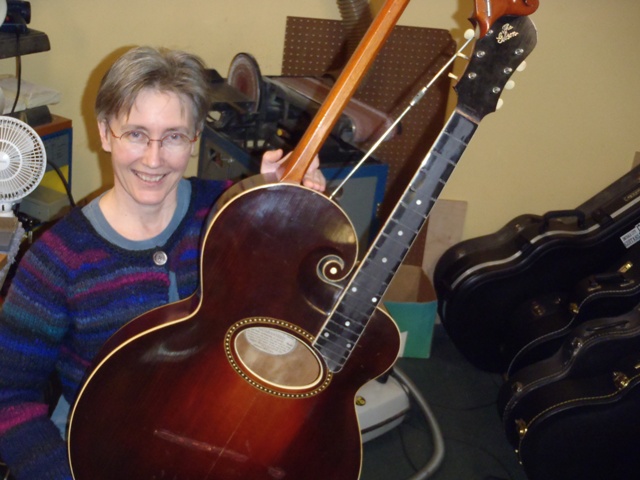
Cat Fox in her box; in her room within a room, is preparing for an upcoming presentation she'll give on keeping chickens… a fowl past-time of hers that seems decidedly wrong for someone with her double-predatory name. On her bench beside a life-like black rubber crow is part of an old Gibson harp-guitar, probably almost 100 years old. She opens up a large case and takes out the reddish full body of the instrument itself, minus its strings and a few other bits. It'll take time and patience to repair and reinforce this giant and to tune it back to its original state, but she'll do it. 

One of Cat's current restoration projects, a Gibson harp-guitar
Instruments that pass through her hands are as good as new, and in some cases look and play better than new. 


I have to leave Cat and Rick to let them work, but I leave with the rich sound of the baritone guitar in my head. It's a wonderful instrument I'm drawn to not only for its voice but also for the wonderful inlaid portrait of a bear that glows like ice from the guitars head. It is as Rick points out the "bearitone" guitar. 


And I leave with a taunting aside from Rick… he'll soon have a used Running Dog mini-jumbo passing through for sale… at an insanely reasonable price. He turns his head sideways with a quizzical look to see if I'm tempted. Of course I'm tempted… I'd love to have a room-full of his guitars! Dreams, dreams, dreams! But I am already proud owner of one Running Dog guitar… maybe I should work toward a pack?

Friday, March 16, 2012

A Winn Winn situation; Paddle a long way around Ireland


This is an unpretentious personal account by Jasper Winn of his solo sea kayaking journey around Ireland . 

Spurred on sometimes by the goal of completing the trip, and sometimes by the goad of realizing how dumb he'd appear if he gave up after proudly announcing to someone in a pub what he aimed to do, Winn pushed his way all around the Irish coast in one of the wettest summers in history. 

I enjoyed Winn's stream-of-consciousness delivery. It's exactly how things pass through your mind on a long solo trip: the anxieties about landing, the possibility of running into something alive and big with teeth, a lusting for food, or company, or uncertainty about what that flashing light means. It's also how things materialize, like flotsam on a beach, sorted by size and type by the waves, or how people appear out of the mist when you think yourself alone, or take you into their home and feed you when you're trying to pin down your tent in a gale.

He sets out to complete his trip planning to find guitars to play and friends to meet in the local pubs, a roof over his head when he gets tired of being storm-bound in a tent and the possibility of a hot shower and a restaurant meal when fancy takes. He's not out to break a record set by anyone else, or win any race, instead it's a personal challenge.

If like me you enjoy sea kayaking, or think you might, and you'd like to know what it takes to launch from your home town to take what comes day by day, or if you'd simply like to know more about Ireland, then you'll find Jasper Winn's book a pleasing read.  

Published by "A Sort of Books" in UK

ISBN  978-0-95600-388-1

Monday, January 2, 2012

Swim with the sharks?

My friend Richard loves swimming. Kayaking together in the archipelago of his native Sweden (where he owns Point65) I've known him strip to his shorts on impulse and sprint, whooping with anticipation up the face of an island to leap from the clifftop into deep water, just for the fun of it! Recently in Florida he decided to cool off in the waters of Boca Grande Pass.

Feeding the sharks?

With a look of disdain at the sign warning of strong currents (Richard loves currents and waves) he strode toward the water. True a swimmer was swept away by the current and drowned here, but the water's warm and inviting, and it's easy to see which way the current is flowing. What could be more inviting?

Boca Grande Pass, current warning

But as Richard prepared for his dip, a passing local approached him with some quiet words of advice. She suggested caution for a reason unrelated to the current. The sign doesn't mention sharks.

Sharks have been known to attack here, even in the shallows. But, I hear you ask, aren't there sharks all around the Florida coast, even in the shallows, and yet there are people swimming all the time without being bitten! Even though about half of all shark attacks in USA occur in Florida, in 2011 there were only 14 reported shark attacks in the entire state in the whole year. from sharkattacksurvivors.com The chances of even being nibbled at are infinitesimally small.

Well, it's true: few people actually get bitten by sharks even when they swim all year round. Humans probably are not the tastiest meal for a fish. But Boca Grande Pass is a rather special place... It's a place where tarpon gather to spawn.

brown pelican above tarpon

Tarpon can grow to 5-8 feet long and weigh 80-280 pounds. Boca Grande Pass is "the place" to go angling for tarpon. Catching a tarpon with rod and line is fine sport fishing; catch and release because tarpon don't make such good eating... for humans. However, it's not uncommon for an angler to bring a tiring 100 pound tarpon close to the boat and to finally land only the head. Sharks, especially hammerheads and bull sharks, are not slow to nip at a weary tarpon on a line. And they gather here in their thousands when there are tarpon about.

So if tarpon grow to 8 feet long, how big are the fish that eat them? The world record for the largest hammerhead shark caught goes to a shark landed in Boca Grande pass in 2006. It weighed 1,280 pounds. Now stuffed and harmless it is on display at Mote Marine, Sarasota. motemarine.org Mote is the perfect place to learn about marine creatures and what they eat before you test the waters.


Stuffed hammerhead shark

Richard is no fool. he's a good swimmer, but he changed his mind about swimming in Boca Grande Pass, just in case. Since there were no reported shark attacks on kayaks in Florida in 2011, and there are some great places to kayak... perhaps a glance at my "Guide to Sea Kayaking in Southern Florida" (Globe Pequot Press) might offer some good alternatives?

available from nigelkayaks store


Thursday, October 27, 2011

Escape to Blake

One of my favorite viewpoints of and from Seattle has always been from the Alaska Way viaduct that ran overlooking  the piers of Elliott Bay. Passing through Seattle on my shortest way home from the airport  I always looked forward to the rejuvenating  view to one side of the steep city streets and tower buildings, with to the other side a spectacular panoramic view of the piers, docks and beyond toward the Olympic Mountains.  


Demolition of the viaduct began this week. The city plans to replace the aging structure with a hopefully earthquake-proof toll-tunnel to by-pass the city center by 2016. Then my route will likely follow the dreary I-5 corridor. But there is an alternative way to experience the wide panorama without going through Seattle.


Out across Elliott Bay and past the peninsula of West Seattle is the small tree-covered Blake Island. 


From Seattle's Golden Gardens Park in northwest Seattle, Blake Island is just a short journey by kayak.   


A lighthouse-hopping mostly coastal route takes you past West Point lighthouse in Discovery Park, across the mouth of Elliott Bay to Alki Point lighthouse, then over the narrow channel to arrive at Blake Island. 


 A quieter more direct alternative down the center of Puget Sound from West Point lighthouse leads directly past the south end of Bainbridge Island to Blake; quiet that is apart from boat traffic which includes the occasional container ship bound to or from Seattle or Tacoma, and ferries crossing the sound. 

If you're lucky you might spot a passing orca or two.


 Blake Island is unbelievably calm compared to the mainland; an oasis of peace within sight of the city. A state park since 1959, the only development is at the northeast corner. Here is the Tillicum resort, with its boat docks and the largest of the island's three camp grounds. 
Ceramic artist Kristin Nelson of krikristudio
The rest of the island, logged of its forest in the mid-1800's at a time of strong timber demand from San Francisco, has grown back into what might be described as a wonderful woodland park.  Through this woodland meander miles of trails, including the round-the-perimeter trail of about 4 miles.

Black tailed deer

 
At the base of the spit on the west side  is the second largest camp ground. Boat moorings offer a mostly sheltered tie-up a few yards offshore the main camp sites. 


Photographer Joel Rogers sets his tent
A more exposed area of the spit is reserved for kayakers and canoeists and is part of the Puget Sound water trail. It's not wilderness, but it is a treat and retreat!
 
Water trail camp sites at the spit
Sunrise over Seattle

"In the view" between Blake Island and Seattle