Showing posts with label Cape Flattery sea kayaking. Show all posts

Wednesday, May 25, 2011

Whale Ears; Bones from a Faeroe Beach.

In 1980 I revisited the Faeroe Islands with a group of kayakers from the south of England. The Faeroe or "Sheep Islands" lie out in the Atlantic roughly halfway between Scotland and Iceland. With big swell that year, coinciding with peak tides, we had some wild rides through the tidal rapids between the islands and around the headlands. But that's why we'd come. With the constriction of the mid-Atlantic tides the water accelerates to 10 miles per hour. Even the lightest breath of wind can produce spectacular white water.


Returning to Torshavn after two weeks, adrenalin appetite sated for now, Drew heard about a whale kill. Some 230 pilot whales from a much larger pod had been herded by small boats into the channel between Streymoy and Eysteroy, to a beach near Havalvik, a town whose very name means "Whale Bay". It was late in the day, but anxious to see, we drove there.

The killing, thankfully, was already over. The whales had been hauled ashore with ropes and now lay on the beach all around the bay in the half-light like a fleet of dark upturned curraghs. We could see the deep cut behind each head which severed the spinal cord to kill the whale. The water must have blazed red with blood.


Each 20-30-foot-long whale had since been disemboweled. The several long cuts needed to open the belly revealed the thinness of the skin, and the thickness of the pinky-white blubber immediately beneath it. These cuts, someone explained, prevented gases building up inside the body cavity. People with buckets were reaching inside the still-warm bodies to pull out the liver and kidneys, which by ancient law belong to anyone who cared to take them. Each whale now had a number carved into its skin to keep tally, the number gleaming white from the underlying blubber.


There was little activity now, save for a few boats zigzagging against the tidal stream in search of any whales that might have sunk after killing.

Dead pilot whales sink, which is the reason they must be so carefully herded to a beach before slaughter. Ironically the so called "right whale" was named simply because it floated after death, so it was the "right whale" to hunt. Whales that would sink were the wrong ones to hunt, unless you could get them to the beach before killing them, as in the Faeroe Islands.

When we had seen enough we returned quietly to Torshavn.

Early next morning Drew hitchhiked back to Hvalvik to see what would happen to the whales. He returned with the surprising news that there had been nothing to see. During the night all the whales had been butchered and the meat and blubber taken away. The entrails and bones had also been disposed of, leaving the beach clean. It seemed remarkable that so much could be done in just a few hours, but I suppose the meat would spoil if left for long.

Meat and blubber is divided around the district by an old and complex system. (see Kenneth Williamson's book "The Atlantic Islands" (1948) for a good description). Blubber is nowadays usually refrigerated and eaten raw, while the meat is frozen, or traditionally dried in strips under the eaves of the house. Hard as bone, these cudgels make ideal provisions for coastal and offshore fishing trips. I tasted slices pared from such a piece with Trondur Patursson, the Faeroese artist and expedition adventurer, at his home, sampling it as he recommended with a piece of raw blubber. It was easy to eat; rich and warming. Patursson took such supplies with him on a skin boat that crossed the Atlantic when he accompanied Tim Severin to retrace the voyage of Saint Brendan in the 1970's. (You can read the story in "The Brendan Voyage" by Tim Severin.)


Revisiting the beach at Hvalvik some years later I spotted a curiously-shaped white stone just an inch and a half long. Perhaps it was a shell? I picked it up. It was heavy for its size, too dense to be bone. It was polished smooth. Turning it in my fingers I was struck by its odd shape. From one angle it appeared like a carving of a shiny bald head with two eye holes peering from the partial shelter of two over-sized hands. A small hole the other side seemed to spiral inward with a pitted texture like octopus suckers. Was it carved? It didn't seem likely. Perhaps it was a fossil. I slipped it into my pocket to look at later.


Farther along the beach I found another, almost identical but a mirror image of the first. Now I searched more carefully! Soon I had a pocketful of pieces of two shapes, the second a distorted "L" shape. They clacked together like stone. So what were they? Whale ear bones! Whale ear bone is the densest of all bone.


So why is whale ear bone so dense? Hearing is all about what happens at the interface between a fixed heavy object and lighter objects that vibrate with sound waves. In humans the sound waves travel through air, which is much less dense than our bodies. The vibrations pass via the ear drum through little ear bones to move the liquid in our inner ear. The movement of the liquid relative to the ear bone stimulates the nerve messages to our brain.

But whales receive sound through water, which has similar density to their body. The whale vibrates with the water. For a whale to hear, something must vibrate less. It's a little like a seismograph frame that vibrates with the earth movements in an earthquake. The heavy weight suspended within the frame vibrates far less, so the instrument can show the relative movement.

A whale operates a little in the same way. The dense ear bone vibrates less than the rest of the whale. Vibrations are transferred via fat pads to the liquid of the inner ear, where the nerves detect the relative movement.

(You can read the original 1980 story about the Faeroe Islands at nigelkayaks

Sunday, December 23, 2007

Thirty years ago in Iceland

Thirty years ago, summer 1977, it felt strange to drive past the bright flags and flapping buntings strung out between the houses and across the streets of the little Sussex village of Burwash. It was as if the village was decorated to see us off; ready to watch the spectacle of Geoff Hunter’s Austin Mini Van with sea kayaks (two of the very first Vynecks) lashed to the roof-rack pass on its way to Iceland, but no, it was the summer of Queen Elizabeth’s Silver Jubilee celebration. Unlike the Queen’s, our procession came to a grinding halt when our paddles flew from the roof; we forgot to tie them down.
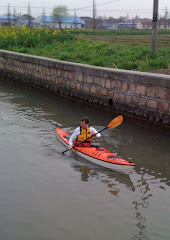
Geoff in his Vyneck in Iceland with fisherman-farmer Axel
Geoff in Vyneck, Iceland with Axel
That year there was a ferry service from Scrabster in Scotland to the Faroe Islands, and this, the first ferry of the season, was greeted by a bagpipe-playing band of kilted musicians striding the quay… another illusion of a personal send-off. We parked Geoff’s minivan in the harbor master’s shed for the summer and carried our weighty kayaks and boxes of gear on board Smiryl for a wild bouncing ride to Torshavn… and then, after four days to recover, for the remainder of the journey north to the snow-coated mountains of eastern Iceland to offload at Seydhisfjordur.
Geoff was a more seasoned paddler than I, having paddled around Britain a few years before in a plywood copy of a Greenland kayak he built himself.
"Angmagssalik Round Britain" about Geoff Hunter's 1970's trip

However he was patient with my pace, as we set off towards the sands of the south coast, about which we’d been warned by everyone who knew anything about Iceland. Dumping surf, quick-sands, sandstorms, no shelter and strong winds were a few warned-of dooms but there was always that back-up plan… we could quit if it proved too much for us. But I know Geoff… he’s not a quitter! We never considered it as more than a back-up plan, even when Geoff was being looped end over end in his Vyneck in the surf off a river mouth where a rapid current fought to help us out through the surf but in the end was not enough. The surf in the end prevented our escape. We finally admitted defeat and were returned to a pounding in the shore break with the day’s mileage total zero. When we changed into dry clothes we found beach sand and grit up to pea-sized nuggets had been forced as far into our clothing as our underpants. Of course, that was before the happy days of latex dry-seals around the wrists… or nowadays even cocoon-like breathable fabric dry-suits that can make kayaking a somewhat dry sport rather than a water sport. Typically our launching provided a sufficiently thorough drenching to set the level of wetness for the whole day, while throughout the night the wet gear dripped to mere dampness if it didn’t rain.
Nigel Foster (left) and Geoff Hunter, South coast Iceland 1977
 
But it was summer, and the weather was often pretty nice! Barring a few storms, and some chill snowy weather in August, we fared pretty well. Sometimes it might have been nice to have had a weather forecast. We could not receive the English-speaking BBC radio programs from home broadcast, and of course this was before portable VHF radios, and before cell-phones. Our best forecast was usually our own observation, but we also asked about the weather when we detoured to buy food supplies.
In 1977 Iceland had almost no kayakers. In the ten weeks we spent in Iceland that summer we met just one kayaker, a man who lived in the northwest fjords. He had been inspired to build his own skin-on-frame kayak after visiting Greenland. But there was no shortage of interesting people! One remote lighthouse holds the biggest private collection of books in Iceland. A handful of fishermen-farmers living in a remote place bury shark meat in the beach for months on end to ferment before hanging it in chunks in drying sheds for more months to reduce the odor… before… well in our case, before offering it to us to taste. Out in the fjords fishing boats approached us to offer us scalding cups of coffee, passed over the side as the vessels rolled low on the swell.
The puffin cliffs near Vik, Iceland
As with all good travel, we had a single well-defined goal to hold the experience together; in this case it was to try to paddle all the way around Iceland. We also had the time to spend doing it. In the south we were invited to stay with a farming family through 6 days of a particularly harsh storm. At Haemay we hiked up the volcano Helgafell, and camped on the beach, still hot since the 1973 eruption. In the northwest we helped with haymaking. We had enough time to get a good feel for Iceland and its people, and by the end it was with sadness that we realized the trip was over. As Geoff said, we should have made it last a bit longer, but perhaps that too is how it should be. It’s a sign of a bad trip if you’re glad when it’s over!
(Left) Raging Rivers Stormy Seas devoted one chapter to a part of the 1977 Iceland circumnavigation
So that was 1977… would I go back to Iceland? Absolutely! It's a brilliant place with great people! I already have returned more than a couple of times; to hike in the interior, to kayak more closely sections of coast we passed quickly, and to driving around the island.

In 2008 I'm going again for the “Eric the Red” sea kayaking symposium. Iceland has a great coastline, and nowadays has a thriving sea kayaking community. See you there? Click here for more about the 1977 Iceland circumnavigation.

Saturday, December 15, 2007

Forty years since the telling… from UK before the end of 2007

In 1967 the British Canoe Union (BCU) magazine “Canoeing in Britain” published a Christmas competition with a prize of a copy of each of “Byde’s Books”. (In 1960 Alan Byde had become just the second person to be appointed Senior Canoeing Coach by the BCU. I’d better explain that in Britain a “canoe” was, and sometimes still does refer to both canoe and kayak.) More about Alan later…

In other news from 1967, a number of people expressed dismay and wrote to criticize one prominent sea kayaker, who shall be nameless, (Chris Hare) oops! Returning from an expedition to Greenland where he had hunted from his kayak with Greenlanders, Chris attempted to gain support for the introduction of seal hunting from kayaks in UK… not in the traditional way, but using a rifle, which was by then the usual way in Greenland. (are there any Seals reading this?)

Colin Mortlock, (later to lead the expedition in Norway, 1975, for which the paddle and kayak designed and used for the journey were also named “Nordkapp”), describes paddling Welsh white-water rivers in flood. His descriptions hint of the hands-on experience he applied to his Charlotte Mason College teachers course in "Adventure Education".

In 1967 an advertisement for the sea kayak, the Wessex Sea Rapier, demonstrated its on-land portability by showing it on the roof of a Morris 1,000 (cc) car… a model of car that I remember had little orange direction pointers that swung out from the supports between the side windows to indicate the direction of an intended turn… In 1967, a fiberglass Sea Rapier cost just 37 pounds 15 shillings… With today’s poor US dollar exchange value that’s about 74 dollars…

The magazine columns that year were full of interesting little revelations, such as “A Canadian is not really a sea going canoe”… and that during 1967, by September, two people had passed the Advanced Canadian examination… (...are there any Canadians reading this?) Next… “The Senior coach is on a par with the Gold Medalist, and is a gentleman to be reckoned with” (...any women reading this?) “To all but a rhinoceros it must be obvious that the only place to learn to roll is the swimming baths – in this country anyway.” (...any rhinos reading this?)

Also in 1967...

Hans Klepper died. He was the son of one of the original tailors who produced the first folding Kleppers in 1905 to speed up trips from the mountains. Han was associated with the design of the Klepper Arius in which Dr Hans Lindemann crossed the Atlantic.

Dave Mitchell (now of Mitchell Paddles in USA) won silver medal for slalom kayak in the world championships.

“The first thermoplastic kayak” was displayed at the annual boat show, (Telephone Kelsall 255) and Bude suffered its annual invasion of competitors for the week-long surf kayaking event.

In this context, back to Alan Byde againAlan wrote a great book titled “Living Canoeing” which according to Alan was started in 1967. Published in 1969, it is a classic, with content still valid today. I can see how later writers have likely been influenced by the style of line drawings that illustrate many of the technical aspects, and by the content of the Sea Kayaking sections of the book. This was not Byde’s first, nor last writing achievement, but I consider it his finest. Returning to the photo of Byde upside down in his kayak on his lawn, you can see similar images (in sequence) in my own "Kayaking; a beginner's guide" and "Nigel Foster's Sea Kayaking". (See "roll" and "books")

(Alan signs a copy of "Living Canoeing", March 2007.)

An intelligent, versatile, yet often controversial figure, Byde retired to New Zealand where, this spring, we found him hiding away from his kayak. With the encouragement of local paddlers such as John Kirk Anderson, I gather he has resumed his participation in his sport and is once again "living canoeing". It was a real pleasure to meet up with and him and his wife in New Zealand; someone who has contributed so much to the sport and never lost his love for it.

(For more of 2007 New Zealand...)

Sunday, November 18, 2007

kayaking below sea level

“Watersheds are difficult places to map, and for that reason (among many others) they are the most fascinating places in the world to explore – debatable lands.” William Bliss, 1935, from the book “Rapid Rivers”.

The Seattle Times today names Seattle as one of the many cities in US to have made efforts to meet the targets of the Kyoto treaty. On a national scale, the current White House doubts there could be such a thing as global warming (“the science is unproven”); hence the refusal to make any move to reduce emissions in case it might “harm US jobs”. According to Max of the Associated Press, “world’s top climate experts” warn that carbon dioxide levels already in the atmosphere commit the world to an average rise in sea levels of up to 4.6 feet above those experienced before the industrial revolution. That’s the rise they expect if polluting factories were shut down today and cars were taken off the roads; we’re already committed to 4.6 feet.
Imagine a gradually rising sea level flooding some homes while others further inland become waterfront property, in the meantime the weather changing a bit and up to 70 percent of all plant and animal species have become extinct, as predicted. Check the plant nursery catalog… we might have to change the type of grass that makes the lawn.
Let’s look at another idea… a slightly different scenario described by the so-called “Ancient Mariner” in William Bliss’s whitewater kayaking (and white-water canoeing) book “Rapid Rivers”. Back in the 1930’s he forecast the mountains of England and Scotland protruding from the sea as; “… a wheen scatter o’ rocky islands!” Anticipating this rise in sea level he prudently bought up foreshore along sections of coast in Australia and South Island New Zealand on the assumption that since the sea level in the Southern Pacific Ocean is currently higher than that of the north Atlantic, and because the retreating ice around the north pole leaves it much thinner than the ice at the south pole, the imbalance would eventually cause the earth to flip pole for pole and cause the sea level to, well dare I say “level out”? At which time… the foreshore he had purchased “down-under” would become land which he would own up to the new high-water mark, considerable tracts since he chose areas with shallow sea, while the land he had sold in Scotland to finance his purchases would rest deep beneath the waves. That land would be worthless. I expect he’s dead by now, seeing as he was old in the 1930’s, and the flood hasn’t happened yet, otherwise I’d love to ask what he thinks about it all now. You’ll have to read “Rapid Rivers” to get more of his story; most of the book consists of gripping accounts, (or perhaps “quaint” would be a better adjective) of first descents of British rivers in the early days of white-water paddling. 
Rapid Rivers by William Bliss, published 1935

But more about rising sea levels; London already built a flood barrier across the Thames to prevent storm surges, which, fueled by the combination of low atmospheric pressure, high tides and wind pushing the North Sea into the land-funnel of Dover Strait, and into the Thames Estuary, occasionally threatened to put London underwater. Since devastating floods in the 1950’s the Netherlands built dikes along the coastal islands, and barriers between, to protect the lowlands of Holland against the same threat. In Holland, pumping the enclosed land dry has caused the land to shrink, not in area but in volume. In places the land is already more than 14 feet below sea level. Given a rise in sea level of 4.6 feet I can imagine Florida either substantially flooded or else, barricaded by dikes, surviving like Holland below sea level. Likewise vast areas of Georgia, the Carolinas… well, you can figure out where the low spots are!
A canal in Delft

Ten ago, 1997, Sea Kayaker Magazine published an article about kayaking below sea level. (I just posted it to my web-site.) 1997: the year of the Kyoto Protocol. We are at a watershed; our decisions now make a difference. In another ten years of global warming, 2017, when the residents of Asia’s large cities are predicted to be at great risk of flooding, we might be able to kayak below sea level in our own back yard.


Tuesday, November 6, 2007

The grease van heads south...


So with the grease van, parked down the street, we sipped cool beers in front of the fire, broke out some wooden instruments and warmed up, Nacho's friend trilling out the notes on his silvery-toned mandolin. But as we warmed up, so the van cooled down... the grease congealed and the van wouldn't start again until coaxed with hot air and patience until the wee hours, when it coughed into action and slipped away into the night leaving a faint smell of late night restaurant kitchen hanging in the chill air.


Check out their route... the Vegetable Oil Road Trip blog has a great description of their sea kayak trip around Cape Flattery on the Olympic Peninsula... classic northwest route! And they're heading onward toward warmer climes....