Thursday, December 31, 2020

Heart of Toba


Where is the world’s biggest volcanic caldera lake? Lake Toba in North Sumatra. And yet this remarkable lake did not appear on the map until 1852 when it was first seen by European eyes. Even then, stories of headhunters and cannibals deterred all but the most dedicated explorers from seeing it.

Order book Heart of Toba now in Paperback and Kindle

Traditional houses at Siallagan village Samosir
Siallagan Village, Ambarita Samosir Island


Map location of Sumatra and Lake Toba
World Map shows location of Lake Toba in North Sumatra

Toba is a super-volcano, one of just half-a-dozen active worldwide. When it erupted some 74,000 years ago it left a hole in the earth’s crust sixty miles long by eighteen miles wide. The explosion was equivalent to a stunning 2,800 times that of the Mount St. Helens1980 eruption in Washington USA. After Lake Toba formed in the basin, bordered by the steep caldera walls, a resurgent volcanic dome of magma pushed up the lake floor. This created Samosir Island, the “Heart of Toba”, an island rivaling in size UK’s Isle of Wight, or Anglesey, but rising to more than 2,500 feet above the lake (more than 5,000 feet above sea level)

Mount Pusuk Buhit beside lake Toba
Paddling toward the sacred volcano, Mount Pusuk Buhit


At the south end of Toba, at Balige, I joined an Indonesian team brought together by our friend and kayaking guide Priyo Utomo. Our aim was to learn about the life and culture of the Batak people who live around the shores of the lake. Toba Batak have distinctive architecture well-suited to the seismically active area. They perform traditional dances and music, have a history of weaving, and hold strong beliefs. We would travel by kayak, making a circuit of the Heart of Toba, staying with, and learning from Batak families, making trips inland to visit sites of interest. 


weaver uses a backstrap loom Sibandang Island
Weaving on a backstrap loom outside house Sibandang Island
 

Exploring Sibandang Island, a younger island than Samosir and the result of a smaller volcanic dome, we visited the home of a weaver who crafted the traditional ulos in her house on a backstrap loom. Sitting on a wooden platform on the floor, she adjusted the tension of the warp on the loom by straightening her legs against a foot-bar, pressing back against the back strap which gives this ancient type of loom its name. Toba Batak weavers are known for the ceremonial ulos cloths they weave. The yarn is often tie-dyed before weaving into Ikat fabric, creating patterns, sometimes like the shimmering of moonlight across a night-blue lake surface.


Iman, son of Sitor Situmorang in kayak
Iman Situmorang

One of my personal goals was to learn what I could of the Toba paddling culture. Before Dutch colonial rule, travel was often easiest by water. The craft used were dugout canoes called solus. Large solus bolon, often sixty feet long or longer, were used for trade, transport, and war. Fishermen paddled shorter solus, built for one or two people. There are still many fishing solus, some dugout and others fabricated from plastic barrels, but the solus bolon fell out of favor when the Dutch built roads and motor ferries.


Fisherman paddling dugout canoe solu Samosir Island
Fisherman paddling a dugout solu


We traveled some days with Iman Situmorang, son of the celebrated Toba Batak poet and writer Sitor Situmorang, learning much about Batak history and tradition from him. On the shores of the lake as evening turned to night, we read Sitor’s poetry out loud. He wrote of dreaming of home, by the lake, while living far from here. Fleeting relationships, a brief love on the way from somewhere temporary to somewhere without meaning. Dreaming of returning to the place he knew and loved, knowing it will have changed, wondering if he could belong if he returned.


Toba Batak gondang band
We are treated to live Batak music with a gondang band.


Sitor Situmorang did come home to rest by the lake, after his death at his home in the Netherlands in 2014. His grave is a simple memorial near the shore at his birthplace Harian Boho. Sitor's journey is complete: ours was just beginning. Next, we would hike into the forest, or what remains of it. The overgrown site of a historic village marks an area once central to the trade of camphor, benzoin and cassia. It was once home to the Situmorang, the wife-giver family to the rajas Sisingamangaraja.  


River stone grave of Sitor Situmorang
The grave of Sitor Situmorang, famous Batak poet.


The stories I gathered were not yet fitting together. Ultimately, they would make sense, and the book Heart of Toba would come to life. 

Book, Heart of Toba, front cover
More about the Book


Tuesday, May 14, 2019

Time for reflection on water


If you spend much time on the water in a kayak or canoe, sooner or later you’re likely to be transfixed by reflections. Sitting so low in a kayak, reflections dominate your view of calm water from even quite close to where you sit. It’s easier to see beneath the surface by looking straight down but in the wider view, without polarized sunglasses, then reflections rule. All that lies beneath the silvered surface is rendered largely invisible.


reflections suggest concrete underwater structures, Nigel Foster
Freeways cross over water Seattle


Trees and branches overhanging rivers and canals,  create scenes of pleasing symmetry. There is a similar visual tunnel effect between the two images below despite their very different locations, France and Missool, Raja Ampat.


Kri Kri Studio owner in plane tree tunnel, Canal du Midi France, Nigel Foster
Reflected plane trees, Kristin Nelson on Canal du Midi France
Whisky16 with arching water palms, Misool Indonesia, Nigel Foster
Arching nipa palms, Misool Indonesia
Some reflections appear more constructed than others. The bold reflected shapes beneath bridges with pillars arches and girders, quiver and gently distort as ripples move between the solid structures. I am left with the impression the solid structure exists beneath me, no matter what the actual depth is, or the real nature of the bottom. (for explanation of the green water color, see my Color of Water blog post)

Reflected dock falsely suggests underwater structure, Seattle, Nigel Foster
Illusion of underwater dock construction, Seattle


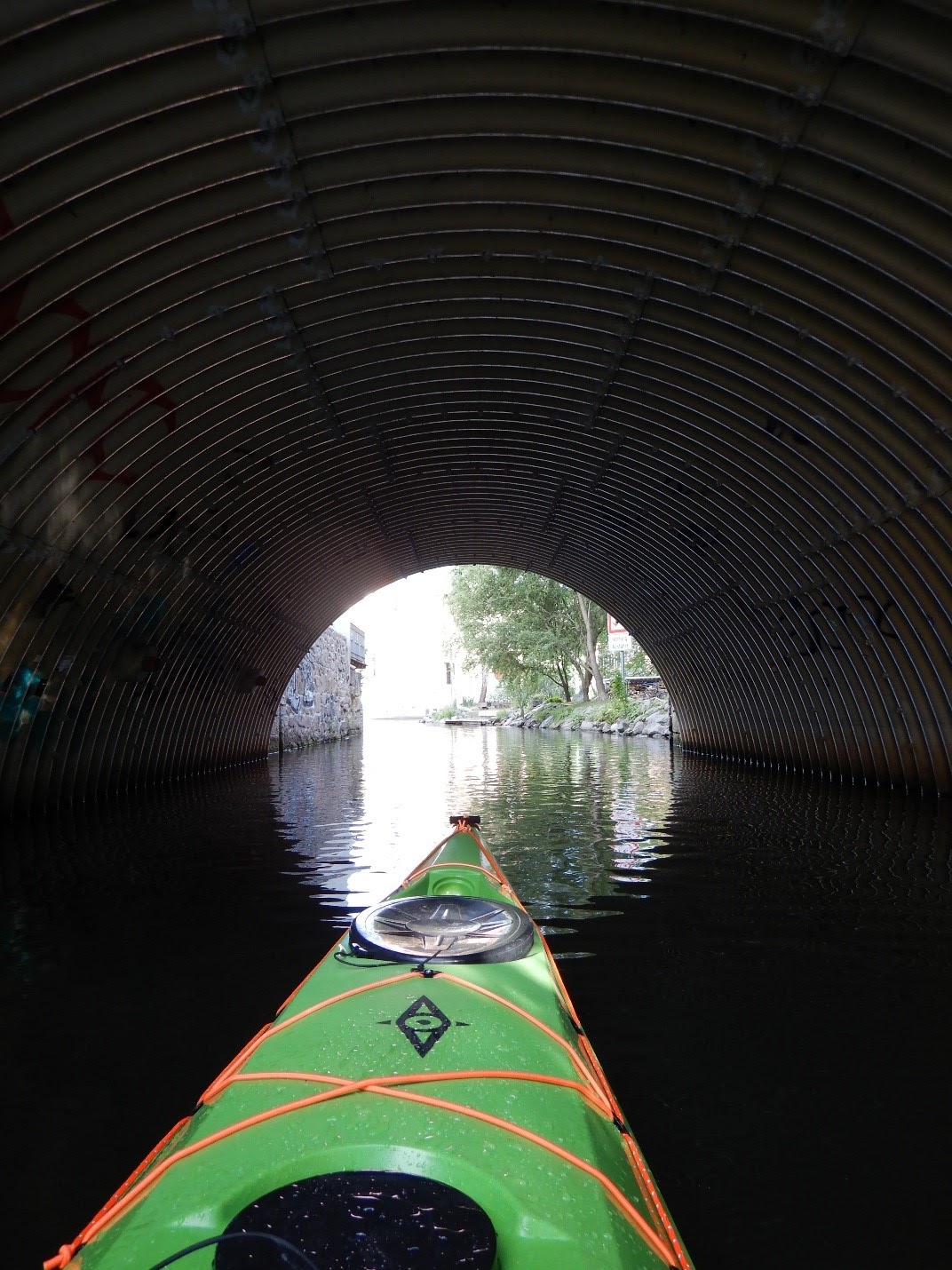
Neither can I resist an opportunity to pause in the face of semicircular arches that are sucked into visual tubes by reflection. Do the curves really continue beneath the surface? Is this structure a tube, or is that just an illusion? The real bottom may be flat, and just beneath the surface, but it’s difficult to discard the impression that it follows the shape and depth of a tube.

Kanu-Funsport reflection creates tubular illusion, Leipzig Germany, Nigel Foster
Illusion of tubular tunnel, Kanu-Funsport Leipzig Germany
Reflected, concrete girders under a freeway that offer nesting shelter for pigeons and surfaces for clandestine graffiti scribblers create optical illusions of solid structures just beneath the placid surface, but as soon as the surface is disturbed the structures morph into dizzily shifting curlicue patterns.

Illusion of freeway girders beneath as well as above canoe, Nigel Foster
Reflected Girders beneath freeway

ruffled water surface creates surreal patterns under Seattle freeway, Nigel Foster
Girders reflected in wavelets

Straight girders shift in reflection into abstract patterns, Nigel Foster
Closer view of reflected girders in wavelets

The eye sees and the mind attempts to make order of the subtly shifting patterns. Only by taking a snapshot of the reflections does it become easier to see why the patterns are so challenging to follow. Even in a snapshot the crisscrossing wave patterns form such twisted reflections that seen out of context they illustrate a puzzling reality. Serving as Rorschach ink blots, the frozen shapes can conjure all manner of things, but rarely reveal the original object that was reflected. When the image is rapidly moving, what chance do you have of making sense of the shifting tree-ring patterns? 


Reflections appear like the grain in cut wood, Nigel Foster
wavelets create tree-ring style patterns


Ripples in motion

Stainless steel anchors, anchor pockets and scratch plates on ship hulls contrast the warping mirror of water, offering steadier mirrored surfaces. Just as from a flat-water surface an individual facet will reflect simply. However, multifaceted surfaces shatter reflections in a completely different way to water, creating collages of recognizable reflected bits of the surroundings.

Mosaic of reflections from ship's anchor and anchor pocket, Nigel Foster
Collage of reflections around anchor 


Water does something similar, but the effect is repeated many more times over by the procession of ripples each presenting its own set of constantly changing reflections from its uniquely morphing three-dimensional curves. Small undulations across an otherwise smooth surface cause shifting curvilinear shapes; shapes that are echoed in art including art from Papua.

Nigel Kayaks abstract art in water reflections, Seattle
Surreal abstract patterns of reflection in water
Although bridges and tunnels and docks offer some amazing reflections, there’s little more pleasing to me than cruising across flat water when the sky is blue with a few fluffy clouds. Looking ahead I have the sensation of flying high above the clouds, which shape-shift beside me as the wake from my bow warps the surface. Close beside my craft the reflected clouds seem to fade, and I can see through them into the water, perhaps seeing fingers of watermilfoil reaching up toward me, or fish darting away. And there on the surface itself, all around me suspended above the mirrored sky is another world of objects too light to sink, too heavy to fly. Here are insects that can walk on water. Here are floating plants, the leaves of waterlilies, feathers and twigs.


Image from On Polar Tides, Nigel Foster, shows kayak cruising above clouds
Cruising above the sky, Labrador (from the book On Polar Tides)
If you've enjoyed this blog post, find more of my creations on Nigel Foster YouTube channel, and on nigel foster vimeo. You can find my books on my store. I'm also available for presentations and special kayak instruction.
Reflection of canoeist shattered by ripples from bow wake, Nigel Foster
Reflection of canoeist, ceramicist  Kristin Nelson shattered by ripples 
The kayaks glimpsed in this post are by Nigel Foster (Point65 DoubleShot and Whisky 16 and Seaward  Kayaks Legend)